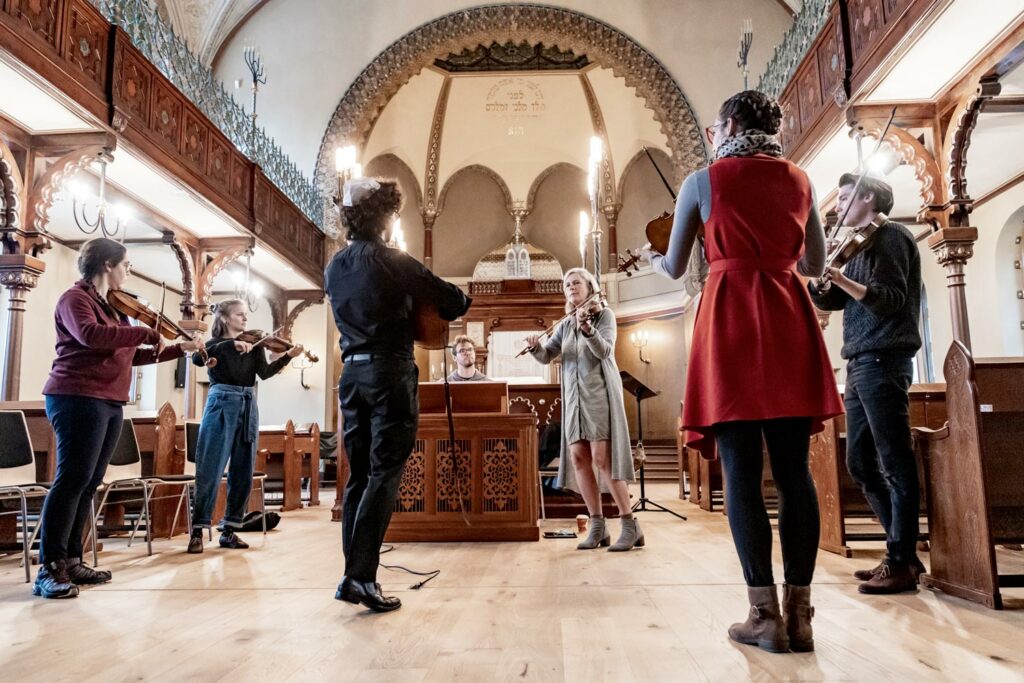
In preparation for your possible participation in the European Hanseatic Ensemble, we would like to provide you with a wide range of experiences during the course, particularly in continuo playing.
Individual lessons
In two 45-minute individual lessons, you will work on continuo repertoire of your own choice, or on the pieces that will be sent to you approximately four weeks before the start of the course.
In one of your two individual lessons, we aim to offer the opportunity to get to know a larger historical organ in Lübeck or the surrounding region. In recent years, we have had access to
On these large historic organs the teachers would like to work with you on both continuo and solo repertoire.
The second individual lesson usually takes place on a single-manual instrument without pedals.
To do justice to both aspects, we ask you to prepare the following repertoire for the masterclasses:
- Two works for solo organ (including at least one work to be performed manualiter)
- two continuo parts (including at least one multi-choir composition)
Continuo lessons while accompanying soloists
In addition to your individual lessons, you will also accompany the vocal and solo instrumental participants during their individual lessons. Some but not all of these lessons will be “supervised”, meaning that a continuo teacher will be on hand to offer advice. You will receive the sheet music for these lessons in advance, and you can of course work on these pieces during your individual lessons.
Single-manual chest organs without pedals and some with a short octave will be available.
Ensemble lessons
Furthermore, an important focus of the course is playing in mixed ensembles. We will provide you with sheet music for the ensemble work in good time before the course begins so that you can prepare. Ensemble lessons usually take place on chest organs.
Cooperation with the Arp Schnitger Academy in Gothenburg
Our cooperation with the Gothenburg International Organ Academy allows us to focus on the use of large organs for continuo playing, in keeping with historical performance practice. As we will encounter on our concert tour in autumn 2027, the special conditions created by these instruments (greater sound volume and variety, as well as significant distance between galleries) require both knowledge and experience. We therefore strongly recommend that applicants also take advantage of the Arp Schnitger Academy in Gothenburg (2–7 August 2026).
There are two tracks in the ASA academy: one for experienced organ players, to include pedaliter solo repertoire by composers from northern Germany, and another for early keyboard players (with less organ experience) including predominantly manualiter early keyboard repertoire. Both tracks include clavichord playing, continuo playing on the world’s largest organ in the Schnitger style (four manuals and pedal, quarter-comma meantone temperament and sub-semitones: d#/e-flat; g#/a-flat; and b-flat/a#), and ensemble workshops with singers and/or instrumentalists. The academy concludes with a participants’ concert. Teachers: Hans Davidsson, Andreas Edlund et al.
Applicants who are accepted to participate in the Lübeck masterclasses have the opportunity to attend the Arp Schnitger Academy in Gothenburg at the reduced price of € 150. Applicants who wish to be considered for participation in our autumn tour to Groningen and Gothenburg in 2027 must first participate in the Arp Schnitger Academy (either in 2026 or 2027) in Gothenburg (the course fee will be reimbursed to ensemble participants after the concert tour).
In order to get to know other historical organs in eastern Sweden, we also recommend participation in the subsequent Schiörlin Academy (9–12 August 2026). Teachers: Hans Davidsson, David Löfgren, Camille Bloche, among others. The focus of this academy will be the unique, completely preserved, late 18th-century organs by Pehr Schiörlin, designed primarily as continuo instruments, with a rich array of sonorities (two manuals and pedal) and well-tempered temperaments.
APPLY NOW